Spain’s Official State Gazette (BOE) published Royal Decree-Law 26/2026 on Wednesday, 30 September 2026. The 96-page Spain housing decree sets out the details behind the measures the Government approved the day before. It takes effect on 1 October 2026, although some measures, such as the new VAT on tourist rentals, apply from later dates.
The decree touches almost every part of the housing market: evictions, rental contracts, rent increases, short-term and tourist lets, first-home loans and property taxes. Whether you rent, own a property or plan to buy in Spain, here is what changes and what it means for you.
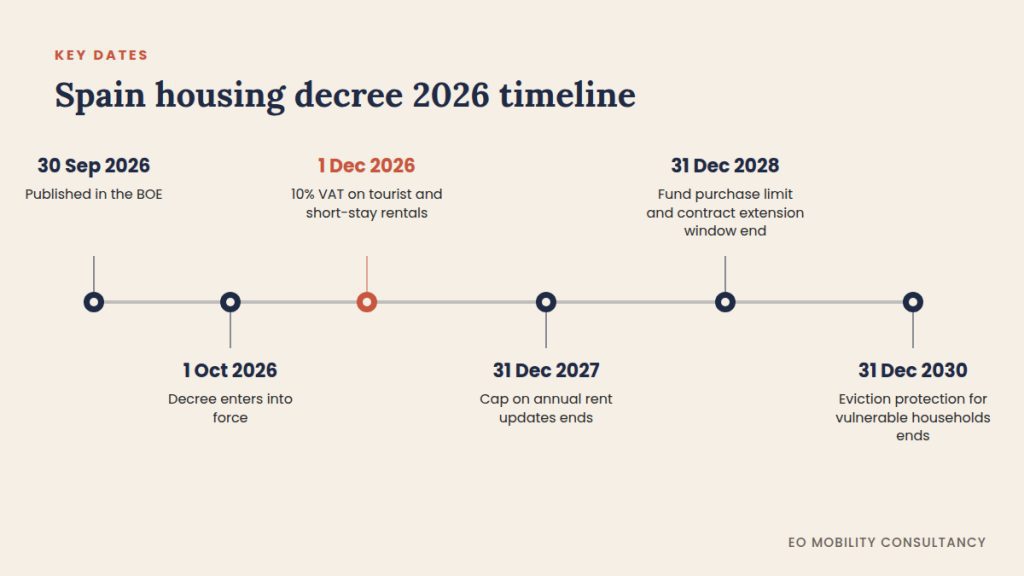
Key dates at a glance
| Date | What happens |
|---|---|
| 30 September 2026 | Decree published in the BOE |
| 1 October 2026 | Decree enters into force (general rule) |
| 1 December 2026 | 10% VAT applies to qualifying tourist and short-stay rentals |
| 31 December 2027 | End of the extraordinary cap on annual rent updates |
| 31 December 2028 | End of the vulture-fund purchase limit and the extraordinary contract extension window |
| 31 December 2030 | End of eviction protection for vulnerable households |
Protections for Tenants in Spain
1. Evictions of vulnerable households suspended until 2030
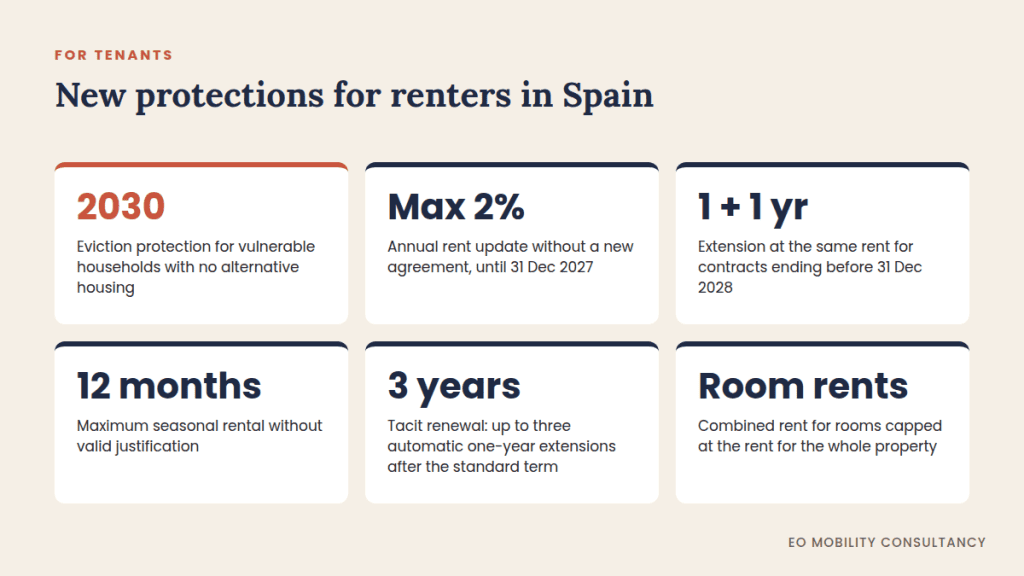
Until 31 December 2030, vulnerable people with no alternative housing are protected from eviction. If the landlord is an investment fund, the court must suspend the eviction, even if a ruling has already been issued.
If the landlord is a small owner, an “extraordinary enervation” applies. When a regional government cannot offer alternative housing, it must pay the tenant’s arrears, and central government will reimburse it. Regions have two months to settle the debt; until they do, the eviction stays suspended.
2. Rental contract extensions with no rent increase
Tenants whose contract ends before 31 December 2028 can request a one-year extension, renewable for one more year. They must be up to date with rent and have paid on time for at least the eight months before the request.
Landlords must accept this extraordinary extension and keep the rent unchanged. The exception is when the owner needs the property for themselves or a first-degree relative.
The decree also amends the Urban Leases Act (Ley de Arrendamientos Urbanos) to add a tacit renewal. Once the standard five-year term ends (seven years if the landlord is a company), the contract renews automatically for one year, up to three times. To prevent this, landlords must give at least four months’ notice and tenants at least two months’.
3. Cap on annual rent increases
From 1 October 2026 to 31 December 2027, annual rent updates are restricted:
- If the rent is already above the maximum set by the official reference price index, no increase is allowed.
- In all other cases, the parties may agree an increase. Without a new agreement, it cannot exceed 2%.
4. New rules for seasonal and room rentals
Seasonal (temporary) rental contracts must state the specific reason the tenant is staying temporarily. The length is freely agreed but cannot exceed 12 months without valid justification. If it runs longer without cause, it is treated as a standard long-term residential lease.
For rooms rented separately in one property, the total rent of all rooms cannot exceed the rent for the whole home. In officially designated stressed residential market areas, the Housing Law’s price limits also apply.
Measures for Buyers and the Housing Market
5. Limits on purchases by vulture funds
Until 31 December 2028, the decree restricts home purchases by so-called vulture funds. The Government defines these as any entity, with or without legal personality, whose corporate purpose includes acquiring property and that tries to buy below 70% of the market appraisal value.
Exceptions include purchases of a primary residence at an affordable or social price for at least five years, and purchases for people needing social and health care, vulnerable groups, victims of gender-based violence, and public bodies that promote or manage social or affordable housing.
6. “Tu Casa”: 0% interest loans for first-time buyers
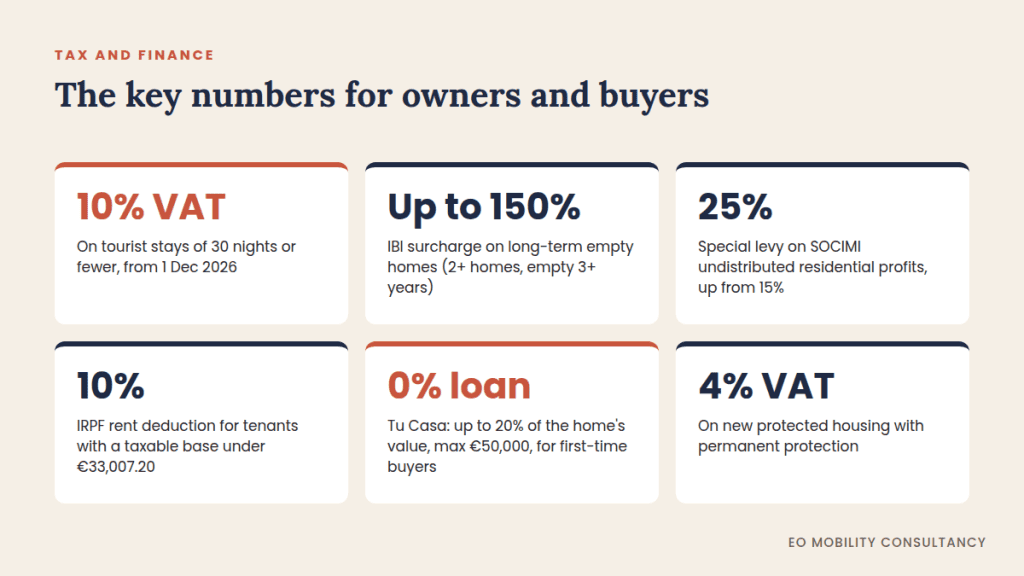
A new financing scheme called Tu Casa helps people buy their first primary residence. It lends up to 20% of the property’s value, capped at €50,000, as a top-up to a private mortgage.
- Term of up to 10 years
- 0% interest and no fees
- A grace period that can last until the mortgage ends, up to 30 years
Homes bought through Tu Casa are permanently subject to a maximum resale price.
7. Public housing protected permanently
Public housing will remain affordable and protected permanently. Newly built protected housing with permanent or indefinite status will carry a super-reduced VAT rate of 4%.
8. State guarantees to finance social housing
The decree creates a guarantee line of up to €2 billion to finance projects that expand or improve social and affordable rental housing. A separate ICO guarantee line of up to €280 million will support industrialised (off-site) construction and investment by manufacturers and developers.
Tax Changes in the Spain Housing Decree 2026
9. Income tax (IRPF) relief for tenants and landlords
Tenants with a taxable base below €33,007.20 a year can deduct 10% of the rent on their primary residence from their state income tax, subject to a maximum base that decreases as income rises.
Landlords keep the general 50% reduction on net rental income, now graded to reward lower rents and penalise steep rises:
| Landlord action | Reduction on net rental income |
|---|---|
| Cuts the tenant’s rent by more than 5% | Up to 100% |
| Standard case | 50% |
| Raises rent by more than 20% on renewal | As low as 15% |
The exact percentage also depends on whether the property is in a stressed area, the tenant’s age and whether the landlord is a large holder.
The decree also changes how income is imputed on non-rented properties, applying a progressive scale to their combined cadastral values. Capital gains from selling homes to the public sector for social or affordable housing can be tax-exempt, within limits.
10. 10% VAT on tourist and short-stay rentals from 1 December 2026
Tourist rentals can be let for less than one month and now have their own tax regime. From 1 December 2026, a furnished apartment or home rental loses its VAT exemption and is taxed at 10% when either applies:
- The landlord provides hotel-style services such as a restaurant, cleaning during the stay or laundry.
- The stay is 30 nights or fewer for the same guest, unless it is the landlord’s own primary residence.
The reduced VAT rate also extends to certain renovation and repair work on homes, including homes rented as a primary residence.
11. Property tax (IBI) surcharges on empty and tourist homes
Town halls can now apply IBI surcharges to residential properties that stay permanently empty. The surcharge can reach 150% for owners of two or more homes that have been empty for more than three years.
In stressed residential market areas, town halls can also add a specific IBI surcharge on homes used as tourist accommodation. It can reach up to 150% for owners of four or more residential properties used this way.
12. Higher tax on SOCIMIs
SOCIMIs (Spain’s listed real estate investment trusts) face a special 25% levy, up from 15%, on undistributed profits from residential rentals, including tourist and short-term lets. The rate can be reduced by 50% or up to 100% depending on how much of their housing is let at affordable rents.
The decree also updates the maximum coefficients for the municipal capital gains tax on urban land (plusvalía municipal).
Who Is Affected and What to Do Now
The decree affects private owners, landlords, real estate companies, tourist apartment managers, booking platforms, SOCIMIs, public housing bodies, and anyone who owns residential property that may face the new local surcharges or IRPF and VAT changes.
The most urgent change is the 10% VAT on tourist rentals from 1 December 2026. Owners, companies and managers should review now:
- Prices and rental contracts
- Terms published on booking platforms
- Invoicing and periodic VAT returns
- Whether they can now deduct input VAT
Tenants with a contract ending before 31 December 2028 should check they meet the eight-month on-time payment rule before requesting an extension.
Frequently Asked Questions
When does Spain’s new housing decree come into force?
Royal Decree-Law 26/2026 entered into force on 1 October 2026, the day after its publication in the BOE. Some measures, such as the 10% VAT on tourist rentals, apply from 1 December 2026.
How much can my landlord raise the rent in 2026 and 2027?
Until 31 December 2027, no increase is allowed if your rent is above the reference price index limit. Otherwise, without a new agreement between you and your landlord, the annual update cannot exceed 2%.
Can I extend my rental contract in Spain?
Yes, if it ends before 31 December 2028 and you have paid on time for the previous eight months. You can request a one-year extension, renewable once, at the same rent.
What is the Tu Casa loan?
Tu Casa is a public 0% interest, fee-free loan for first-time buyers. It covers up to 20% of the home’s value, up to €50,000, alongside a private mortgage. We always recommend to check the small letter.
Do tourist rentals in Spain now pay VAT?
From 1 December 2026, stays of 30 nights or fewer, or rentals with hotel-style services, are taxed at 10% VAT, unless it is the landlord’s own primary residence.
Moving to or Renting in Spain? Get Expert Guidance
The 2026 housing decree is one of the biggest shake-ups of Spain’s rental market in years. If you are relocating, renting or buying in Spain, understanding your rights under the new rules can save you money and stress.
At Eo Mobility Consultancy, we help individuals, families and companies find a home in Spain and navigate the rules that come with it. Contact our team for advice tailored to your move.
This article is for general information only and does not constitute legal or tax advice. As a Royal Decree-Law, the measures must be validated by the Spanish Congress within 30 days of publication. Always check the official text in the BOE or consult a qualified adviser before making decisions.
Stay tuned for more information on rental prices in Spain by visiting our blog and social media.
Want to learn more about the different rental contracts in Spain? Head over to our blog entry here.
Looking for updates and trends on the Spanish Rental Market? Search here.