Spain’s housing market continues to face significant imbalances in 2026, with demand far outstripping supply in both the rental and property markets.
The latest data from the Rental Observatory’s Q2 2026 Rental Barometer and Eurostat reveal a market characterized by a shrinking supply of rental homes, rising rents, intense competition among tenants, and one of the fastest-growing house price increases in the European Union.
Rental Supply Continues to Decline
According to the Q2 2026 Rental Barometer, the shortage of rental properties remains the main source of imbalance in Spain’s residential market. The report estimates that 22,927 rental homes will disappear from the market during 2026, reducing the total rental stock to 660,993 properties nationwide.
The report attributes this decline primarily to two factors, most notably the impact of housing regulations in areas officially designated as “high-pressure” rental markets. These measures continue to push some properties out of the traditional residential rental market.
Catalonia is expected to see one of the sharpest declines, with rental supply projected to fall to 94,947 homes, a 7.65% decrease. Meanwhile, the Community of Madrid remains Spain’s largest rental market, maintaining approximately 150,000 available rental properties.
Demand Reaches Record Levels
While supply continues to shrink, demand remains exceptionally strong.
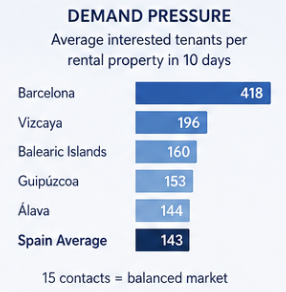
Across Spain, each rental property attracts an average of 143 prospective tenants within just ten days of being listed, up from 135 applicants at the end of 2025. The Rental Observatory considers a balanced market to be around 15 enquiries per property, highlighting just how competitive today’s market has become.
Barcelona records the highest demand pressure, with 418 interested renters per property. Other provinces experiencing particularly intense competition include:
- Vizcaya: 196
- Balearic Islands: 160
- Guipúzcoa: 153
- Álava: 144
- Valencia: 138
- Madrid: 136
- Zaragoza: 127
- Las Palmas: 123
- Tarragona: 118
- Santa Cruz de Tenerife: 116
- Girona: 108
These figures illustrate the severe shortage of available rental housing across much of the country.
Rental Prices Continue to Rise
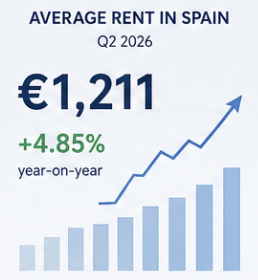
Spain’s average monthly rent reached €1,211 in the second quarter of 2026, representing a 2.28% increase compared with the end of 2025 and a 4.85% year-on-year increase.
Although rental price growth is gradually slowing, rents continue to climb across most regions. The number of provinces where average monthly rents exceed €1,000 has now risen to thirteen.
The country’s most expensive rental markets remain:
- Barcelona: €1,646 per month
- Madrid: €1,637 per month
- Balearic Islands: €1,678 per month
These regions continue to experience the greatest pressure from both limited supply and exceptionally strong demand.
Spain Among Europe’s Fastest-Rising Housing Markets
The upward trend is not limited to rentals. According to Eurostat, Spain recorded one of the strongest house price increases in the European Union during the first quarter of 2026.
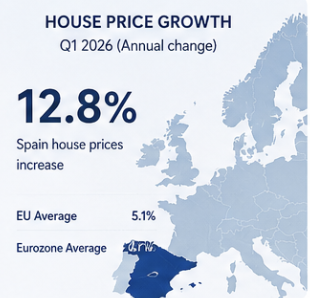
Residential property prices rose 12.8% year-on-year, more than double the EU average of 5.1% and the eurozone average of 4.7%.
This makes Spain the fifth fastest-growing housing market in the EU, behind only:
- Portugal (17.8%)
- Bulgaria (14.8%)
- Slovakia (14.4%)
- Croatia (14.3%)
At the opposite end of the ranking, Finland was the only EU country where house prices fell, recording a 2% annual decline.
Conclusion
Spain’s housing market remains under considerable strain as the imbalance between supply and demand shows little sign of easing. A declining rental stock, sustained demand, and steadily rising rents continue to make finding affordable housing increasingly difficult. At the same time, rapid growth in residential property prices places Spain among Europe’s hottest housing markets. Unless housing supply expands significantly or demand moderates, pressure on both renters and homebuyers is likely to remain a defining feature of the Spanish housing market throughout 2026.

Thinking about renting, investing, or relocating in Spain?
Get expert guidance tailored to your situation, whether you’re searching for a home or exploring property opportunities.
Contact us today to navigate Spain’s fast-changing housing market with confidence.
Stay tuned for more information on rental prices in Spain by visiting our blog and social media.
Want to learn more about the different rental contracts in Spain? Head over to our blog entry here.
Looking for updates and trends on the Spanish Rental Market? Search here.
Key Takeaways
- Rental supply is projected to fall by 22,927 homes during 2026, leaving around 661,000 rental properties nationwide.
- Average demand has reached 143 prospective tenants per rental property within ten days of listing, compared with a balanced market benchmark of just 15.
- Barcelona experiences the highest rental competition, with 418 applicants per property.
- The average monthly rent in Spain now stands at €1,211, up 4.85% year-on-year.
- Thirteen Spanish provinces now have average monthly rents above €1,000.
- The most expensive rental markets are the Balearic Islands (€1,678), Barcelona (€1,646), and Madrid (€1,637).
- Spain’s residential property prices increased 12.8% year-on-year in Q1 2026.
- Spain recorded the fifth-highest house price growth in the European Union, well above both the EU and eurozone averages.