Spain’s rent cap for 2027 is now law, but only just.
On 12 November 2026, Parliament’s standing committee (the Diputación Permanente) approved the government’s main housing decree by 35 votes to 34. In the same week, new data showed property prices still climbing around Madrid and Barcelona, and 1 in 6 rental homes being let within 24 hours of going online.
For anyone renting in Spain or relocating here, the message is mixed. Spain’s rent cap for 2027 is at 0–2%, but the market itself shows no sign of cooling, and the 29 November general election could change the rules AGAIN.
Spain’s housing week at a glance
- Housing decree (RDL 29/2026): approved 35–34 on 12 November
- Second decree (RDL 28/2026): rejected 34–35, so automatic lease renewals never took effect
- Rent updates in 2027: 0% or a maximum of 2%, depending on the reference index
- Madrid province prices: +13.1% year on year, €3,963/m² on average
- Biggest rise near Madrid: Torrejón de Ardoz, +30%
- Rentals let in under 24 hours: 16% nationally, 35% in Barcelona
Why the vote came down to one seat
The full Congress rejected both housing decrees on 2 October 2026, a defeat that led Prime Minister Pedro Sánchez to call a snap election. The government re-approved them on 6 October 2026. With the chamber dissolved, the standing committee was the only body left to vote on them.
Royal Decree-Law 29/2026, the broad housing package, passed with PSOE, Sumar, ERC, EH Bildu, PNV and Podemos in favour, and PP, Vox and Junts against. The Basque PNV once again decided the result.
The second text, Royal Decree-Law 28/2026, promoted by Sumar, failed by the same single vote after the PNV sided with the opposition. It would have made residential leases renew automatically and indefinitely, and forced landlords to pay tenants 12 months’ rent for breaking a contract. It was due to start on 15 November 2026, so it never applied.
The vote came a day after Spain’s first general strike since 2012, called by the tenants’ union over housing access.
Can my landlord raise my rent in 2027?
For many tenants, the answer is no, and for the rest it is 2% at most. The decree has been in force since 8 October 2026 and caps annual rent updates until 31 December 2027:
| Your current rent | Maximum rise in 2027 |
|---|---|
| Above the top of the reference index band for your home | 0% |
| Below the top of the band (unless you agree otherwise) | 2% |
The band comes from the Ministry of Housing’s State Reference Price Index.
Extending your rental contract
If your contract ends before 31 December 2028, you can ask for an extraordinary extension of up to two more years, one year at a time, with rent held to the same caps. The landlord must accept if you meet the legal conditions, mainly being up to date on rent, including the last eight monthly payments. The exceptions are narrow, mainly when the owner or close family needs the home. The government estimates around five million people could benefit.(If you need help reviewing the lease, click here),
Other measures in the decree
- Evictions: evictions of vulnerable households with no alternative housing are suspended until 31 December 2030, especially where the landlord is a large holder. The regional government then has two months to offer housing or cover the amounts owed.
- Room rentals: the total paid by all tenants of rooms cannot exceed the rent for the whole home.
- First-time buyers: the “TU CASA” programme offers interest-free public loans of up to €50,000 to help buyers without savings cover upfront costs. The conditions are still to be set.
- Landlord tax breaks: income-tax reductions of up to 100% for landlords who cut rent by more than 5% when renewing with the same tenant, with lower tiers of 95%, 85%, 70% and 50%.
- Tourist rentals: 10% VAT on stays under 30 nights from 1 December 2026, and local property-tax surcharges of up to 150% in stressed areas.
- Affordable housing and Socimis: 4% VAT on publicly promoted affordable housing, and the tax on undistributed profits of residential Socimis rises from 15% to 25%.
Why the uncertainty hasn’t gone away
The vote confirms the measures only for now. The PP has promised to scrap the government’s housing interventions if Alberto Núñez Feijóo becomes prime minister after 29 November 2026. Vox has filed a legal challenge against using the standing committee to revive texts the full Congress had rejected. Madrid regional president Isabel Díaz Ayuso says her government will not apply the parts within its powers, in practice the room-rental limits.
The industry is warning about supply. The estate agents’ federation FAI expects a 25–30% drop in rental transactions in the coming months. Its early data counted 2,067 homes withdrawn from long-term renting, many moved to sale or to seasonal and room lets. Some investors say the rules changed twice in five weeks and have pulled flats off the market.
Prices keep climbing around Madrid and Barcelona
Tinsa by Accumin’s third-quarter 2026 data shows prices at new highs, with the commuter belts rising faster than the cities. In Madrid province, prices rose 13.1% year on year and 0.9% on the quarter, to €3,963/m². Twelve of the 16 municipalities analysed grew faster than the capital.
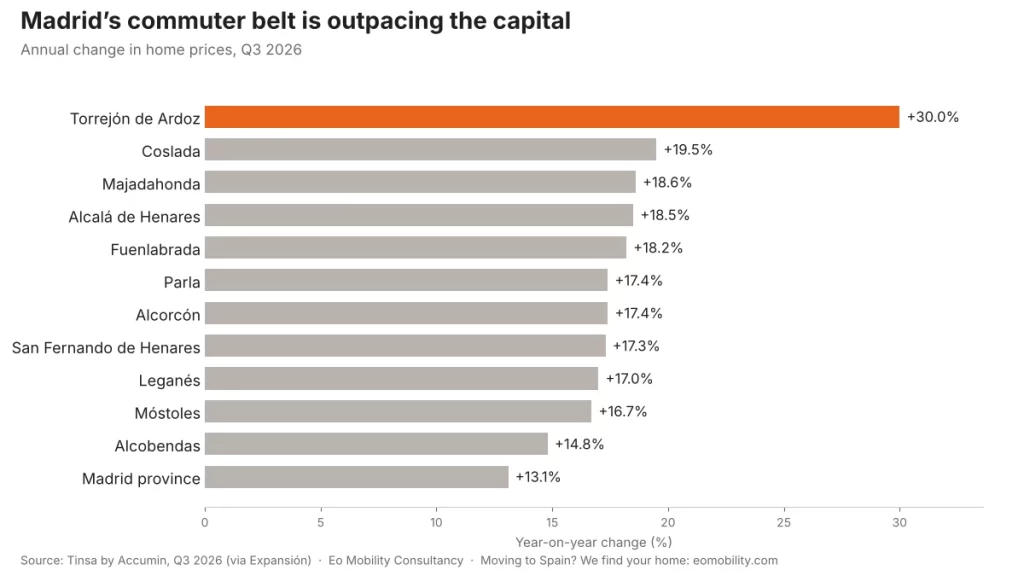
Prices range from €4,853/m² in Pozuelo de Alarcón to €2,297/m² in Parla. Madrid city is second at €4,765/m², just ahead of Majadahonda (€4,753), Alcobendas (€4,499) and Las Rozas (€4,086). Growth is slowing in 13 of the 16 municipalities, but annual rates still run at 10–18%.
Around Barcelona, all 27 municipalities analysed rose, by 3.1% to 24.8% year on year, with Viladecans at the top. Sales are cooling, though: down 17.9% in Barcelona city and 14.8% across the province. Nationally, purchase prices rose 13.7%, with nearly four buyers competing for every home listed.
Affordability is the starkest signal. Buying takes more than the national average of 36.9% of household income in every Madrid-area municipality, and 13 of the 16 exceed the 45% level seen as critical. Madrid province as a whole sits at 53.5%. Around Barcelona, 56% of towns are above 45%.
One rental in six goes in under 24 hours
An idealista study found that 16% of homes rented through the portal in Q3 2026 had been listed for less than a day.
| City | Rentals let in under 24 hours |
|---|---|
| Ceuta | 50% |
| San Sebastián | 37% |
| Huesca | 36% |
| Barcelona | 35% |
| Lleida | 32% |
| Vitoria | 30% |
| Girona | 28% |
| Pamplona | 25% |
| Bilbao | 16% |
| Málaga | 14% |
| Valencia | 13% |
| Madrid | 10% |
Listings now draw an average of 43 contacts, up from 8 in 2018, and as many as 137 in some areas. Before the decrees, seasonal and room lets already made up 55.8% of the market.
Relocating to Barcelona or Madrid? In markets where a flat can be gone in a day, being on the ground matters. See how Eo Mobility’s home search works.
What this means if you’re renting or relocating to Spain
- Check your reference band now. If your rent is above it, your landlord cannot raise it in 2027.
- Ask about the extension. If your contract ends before the end of 2028, you may be able to stay up to two more years at capped rent.
- Move fast on new rentals. In Barcelona, San Sebastián or Vitoria, a good flat may be gone within a day.
- Watch the election. A change of government after 29 November could reverse these measures, so get advice before you sign anything long-term.

How Eo Mobility can help you find a home in Spain
A 2% rent cap doesn’t help if you can’t get the flat in the first place. In cities where one in three listings goes within 24 hours, newcomers lose out to locals who know the market, speak the language and have their paperwork ready. That’s the gap we close.
Eo Mobility is a Barcelona-based relocation and immigration consultancy. We support relocating employees, HR teams and private clients across Spain.
- Home search and home finding: we shortlist homes that match your budget and commute, arrange viewings and move quickly when the right one appears, with pre-view orientation so you know each neighbourhood before you arrive.
- Paperwork ready before you view: we help you prepare the documents landlords ask for, so you are ready from the start.
- Guidance on the new rules: we explain how the 2027 rent cap, the reference index and the contract extension apply to your home, so you know what to expect before you sign.
- Immigration and compliance: visas, NIE and local registrations handled alongside the home search, so one doesn’t hold up the other (when possible).
- Schools and settling in: school search, language and cultural training, and support for accompanying partners.
For HR teams and relocation companies: a market this fast turns home search into the longest part of a move. We give your assignees a local team on the ground and keep you updated at every step. Find out more for Corporate HR.
Moving to Spain in 2027? Tell us where and when, and we’ll build a home-search plan around your dates. Request a quote or contact our team.
Sources: Expansión, 12, 13, 14 and 16 November 2026 (links below); Tinsa by Accumin Q3 2026; idealista; FAI.