The Spanish rental market continues to lose homes. According to the Rental Observatory (Observatorio del Alquiler) run by the Fundación Alquiler Seguro, 16,644 fewer homes were available to rent in the third quarter of 2026 than on average last year. That’s a 2.4% drop. Over the past five years, supply has fallen 35.7%, so roughly one in three rental homes has disappeared.
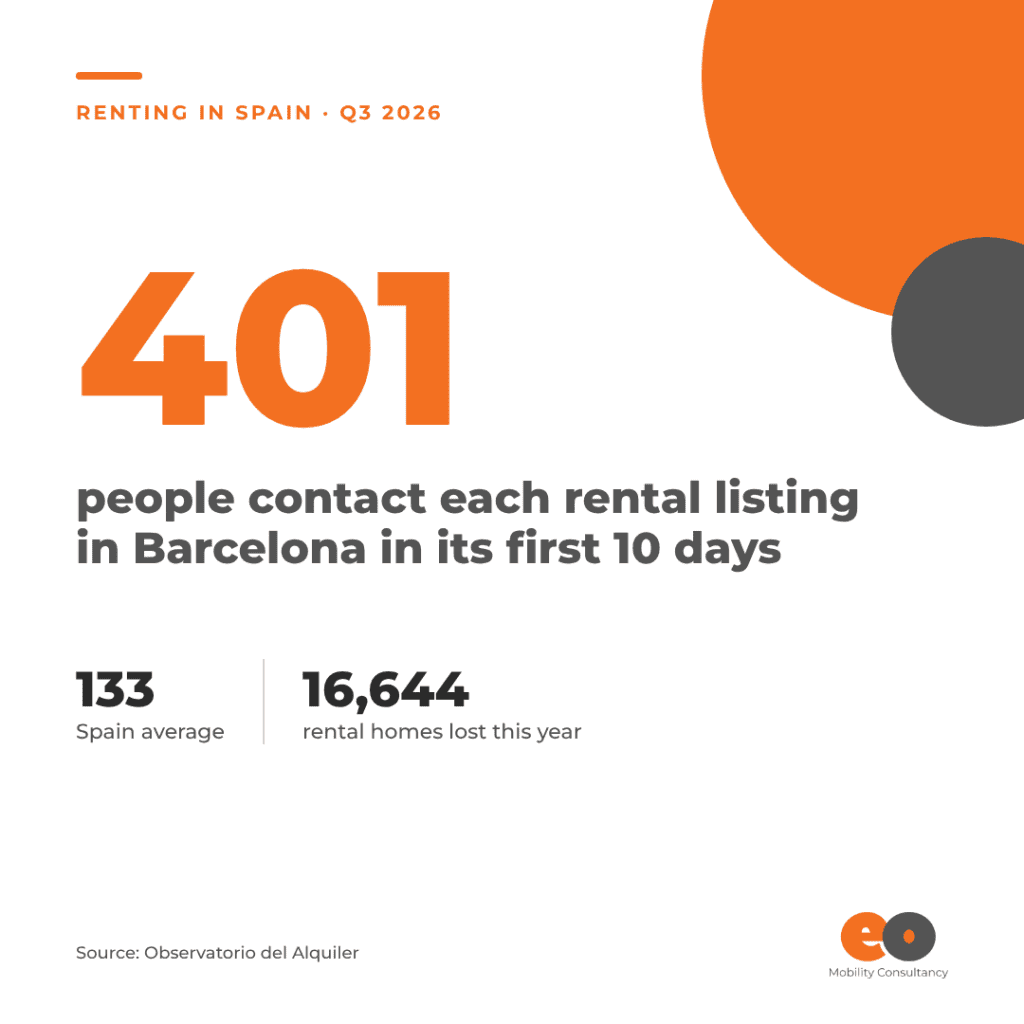
Demand, meanwhile, shows no sign of easing. Each new listing receives 133 enquiries in its first 10 days, rising to 401 in the province of Barcelona. Industry groups warn that the government’s new housing decrees, designed to give tenants more protection, are adding legal uncertainty and pushing even more landlords out of the market.
Spain’s rental shortage at a glance
- Rental homes lost this year: 16,644 (−2.4%, 2025 average vs Q3 2026)
- Five-year fall in supply: −35.7%
- Enquiries per listing in the first 10 days: 133 (143 the previous quarter)
- Barcelona province: 401 enquiries per listing
- Biggest falls: Ceuta (−28.5%), Gipuzkoa (−26.9%), Navarre (−20%)
- Biggest rises: Ourense (+14.6%), Ávila (+13.6%), Salamanca (+12.9%)
Where Spain lost the most rental homes
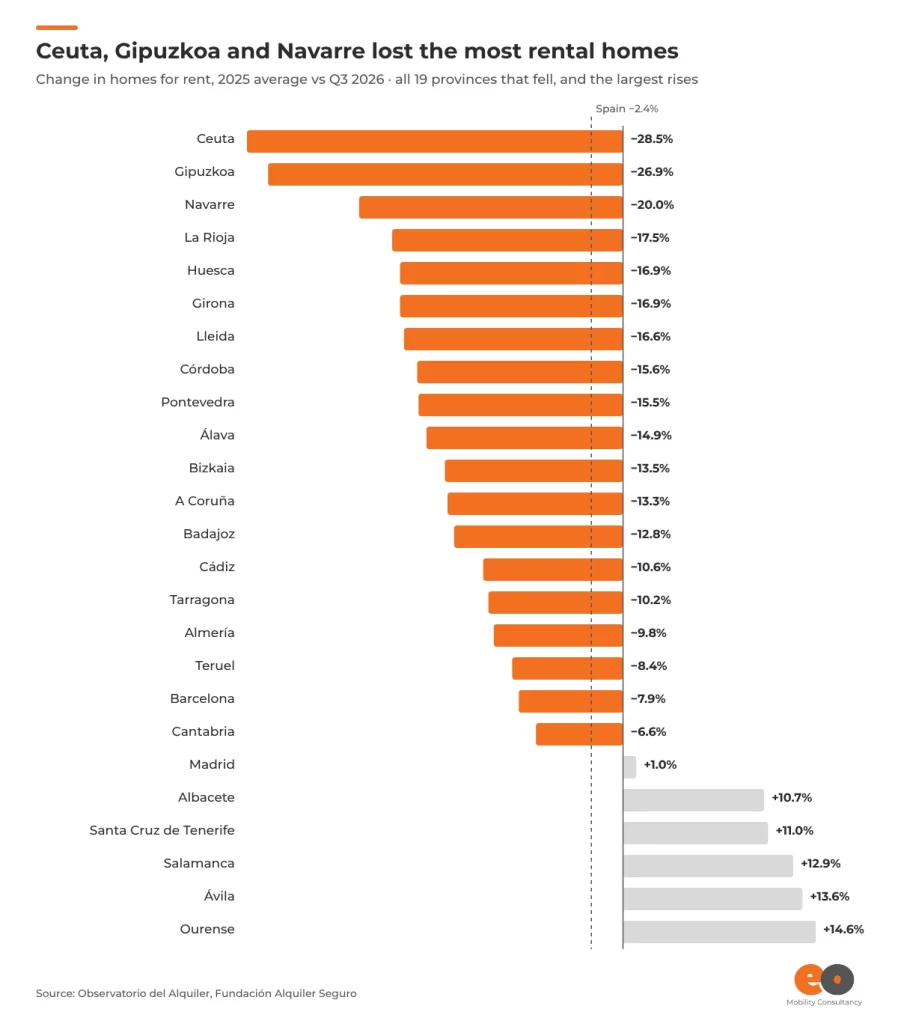
The decline is very uneven. Ceuta recorded the steepest fall (−28.5%), which the report links to the migration pressures the city faced this summer. The Basque Country, Navarre and Catalonia are also hit hard.
| Province | Change in rental homes (2025 avg vs Q3 2026) |
|---|---|
| Ceuta | −28.5% |
| Gipuzkoa | −26.9% |
| Navarre | −20.0% |
| La Rioja | −17.5% |
| Huesca | −16.9% |
| Girona | −16.9% |
| Lleida | −16.6% |
| Córdoba | −15.6% |
| Pontevedra | −15.5% |
| Álava | −14.9% |
| Bizkaia | −13.5% |
| A Coruña | −13.3% |
| Badajoz | −12.8% |
| Cádiz | −10.6% |
| Tarragona | −10.2% |
| Almería | −9.8% |
| Teruel | −8.4% |
| Barcelona | −7.9% |
| Cantabria | −6.6% |
Stressed housing zones and the drop in supply
The report points to two causes.
First, strong population growth: new households are forming at three times the rate new homes are being built.
Second, regulation that discourages owners from renting out their property, a problem it says has worsened in recent weeks as the new rules raise uncertainty over new contracts.
It also finds a close link between the regions that have declared stressed housing zones (zonas tensionadas) and the steepest falls in supply. Under Spain’s Housing Law, these are areas where rent controls can apply, and they include parts of Catalonia, the Basque Country, Navarre, Asturias and Galicia. These regulations are driving potential landlords away.
How many people chase each rental listing
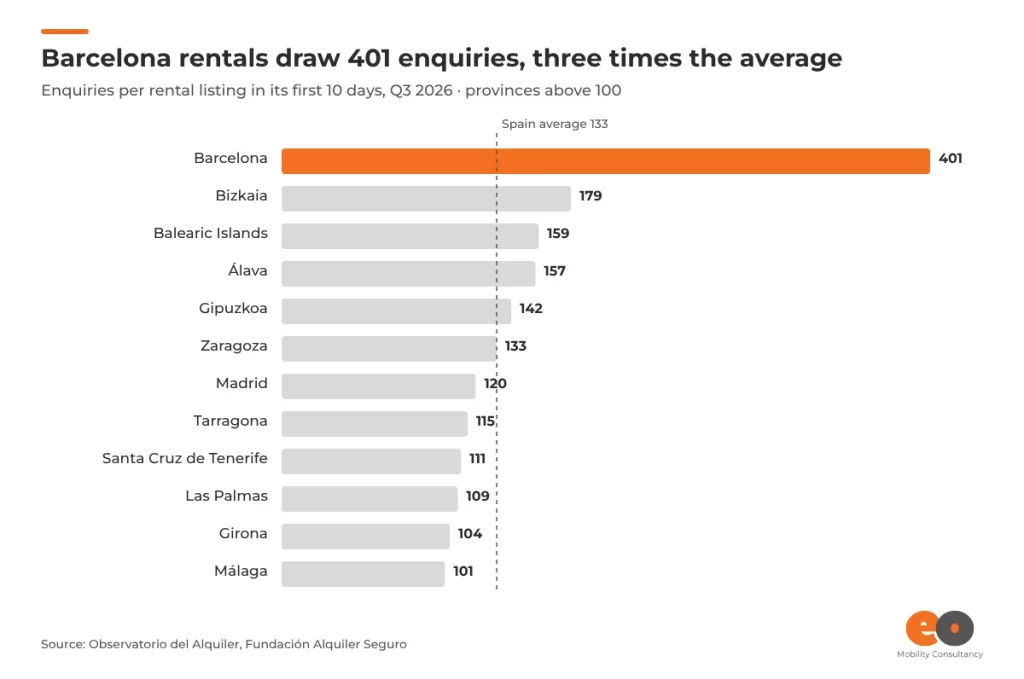
With fewer homes on offer, demand for each one stays close to record highs and keeps pressure on prices. The national average of 133 enquiries in the first 10 days is slightly down from 143 the previous quarter, but Barcelona is in a league of its own.
| Province | Enquiries per listing (first 10 days) |
|---|---|
| Barcelona | 401 |
| Bizkaia | 179 |
| Balearic Islands | 159 |
| Álava | 157 |
| Gipuzkoa | 142 |
| Zaragoza | 133 |
| Madrid | 120 |
| Tarragona | 115 |
| Santa Cruz de Tenerife | 111 |
| Las Palmas | 109 |
| Girona | 104 |
| Málaga | 101 |
What this means if you’re looking to rent in Spain
- Expect competition. In Barcelona, the Basque Country and the Balearics, listings draw hundreds of enquiries, so reply within hours, not days, and be ready to drop everything to attend a visit
- Have your file ready.
- Widen the search. Provinces such as Ourense, Salamanca, Zaragoza and Seville are adding rental homes rather than losing them.
- Check whether the home is in a stressed zone. Different rent rules may apply there, so get advice before you sign.
FAQs
- Why is it so hard to rent a flat in Spain? Supply has fallen 35.7% in five years while household numbers keep growing. Each listing now draws 133 enquiries in its first 10 days on average.
- How many people apply for a rental in Barcelona? About 401 people contact each listing in Barcelona province in its first 10 days, three times the national average.
- What is a stressed housing zone in Spain? It’s an area declared under Spain’s Housing Law where rent controls can apply. Regions with these zones have seen some of the largest falls in rental supply.
- Which provinces are adding rental homes? Ourense (+14.6%), Ávila (+13.6%), Salamanca (+12.9%), Santa Cruz de Tenerife (+11%) and Albacete (+10.7%) recorded the largest increases.
Moving to or Renting in Spain? Get Expert Guidance
The 2026 housing decree is one of the biggest shake-ups of Spain’s rental market in years. If you are relocating, renting or buying in Spain, understanding your rights under the new rules can save you money and stress.
At Eo Mobility Consultancy, we help individuals, families and companies find a home in Spain and navigate the rules that come with it. Contact our team for advice tailored to your move.
Stay tuned for more information on rental prices in Spain by visiting our blog and social media, or reading our latest article here.
Want to learn more about the different rental contracts in Spain? Head over to our blog entry here.
Looking for updates and trends on the Spanish Rental Market? Search here.